Northeast India Is Building — and You Need the Right Machine
The Seven Sisters of Northeast India — Assam, Arunachal Pradesh, Nagaland, Meghalaya, Mizoram, Tripura, and Manipur — are in the middle of one of the most significant construction booms in their history. According to IBEF’s latest infrastructure report, railway projects worth ₹77,000 crore are currently underway in the Northeast alone — the region’s highest-ever investment in rail. And that is just the railways.
From the Guwahati Metro to 16,207 km of national highways already built across the Northeast, every corner of this region is being built up at a pace never seen before. Behind every new school, hotel, government building, and housing colony is one critical material: the brick. And behind every brick is a machine.
That is why understanding brick making machine price in Northeast India matters more than ever in 2026. Whether you are a small entrepreneur in Guwahati, a contractor in Shillong, or a developer in Imphal, this guide gives you a complete, region-specific breakdown of brick making machine prices, the types of machines available, and how to choose the right one for your local market.
Why Northeast India’s Construction Sector Is Booming in 2026
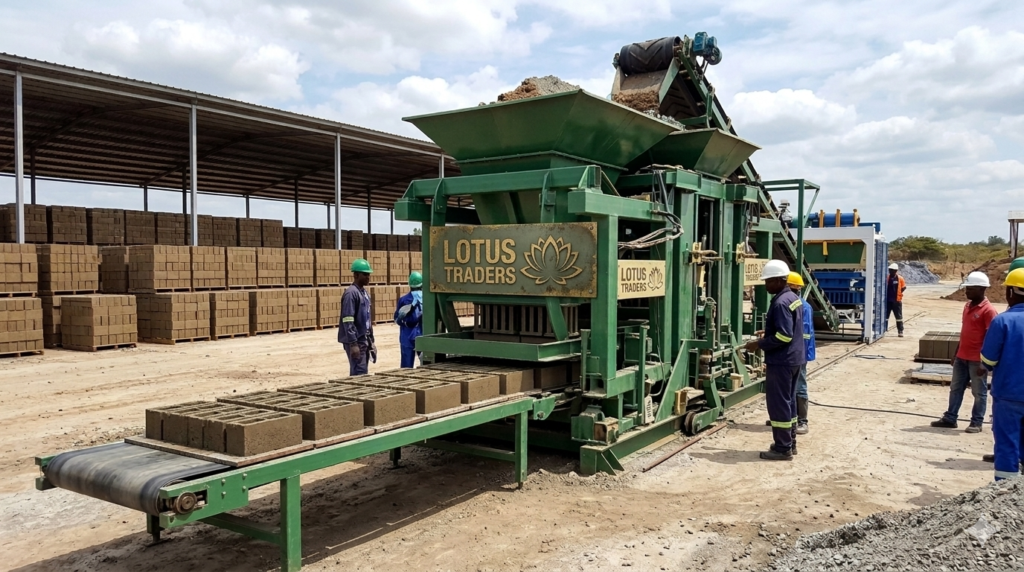
To understand why brick making machines are in such high demand across the Seven Sisters, you need to understand the scale of development currently underway. India’s construction industry is projected to expand by 8.1% in real terms in 2026, with the Northeast set to outpace the national average thanks to historic levels of central government investment.
- According to IBEF, railway projects worth ₹77,000 crore are underway in the Northeast — representing the region’s highest-ever rail investment.
- The Special Accelerated Road Development Programme for North-East (SARDP-NE) has driven construction of 16,207 km of national highways in the region as of July 2025.
- The Guwahati Metro — a 61 km, 54-station urban transit network — is under active construction, driving massive demand for bricks and building materials across Assam.
- The Pradhan Mantri Awas Yojana (PMAY) 2.0 scheme, active since September 2024, targets construction of 1 crore new homes over five years — with hill states and northeastern states receiving higher financial assistance of ₹1.30 lakh per house.
- India’s National Highway construction pace has risen 2.8 times since 2014-15, with road capex surging five-fold to ₹3.01 lakh crore in 2023-24.
This wave of development is creating sustained, long-term demand for bricks across all seven states. Entrepreneurs and contractors who invest in a quality brick making machine today are positioning themselves at the center of this growth.
Tourism Is Also Driving Construction: The Northeast’s Hidden Demand Driver
Beyond government infrastructure, the Northeast’s booming tourism sector is generating a parallel wave of construction. Every new destination needs accommodation, resorts, and support infrastructure. Here is what is happening on the ground across the Seven Sisters:
Major Tourist Hubs Fueling Local Construction Demand
Assam — Kaziranga & Guwahati: Kaziranga National Park — a UNESCO World Heritage Site and home to two-thirds of the world’s one-horned rhinoceroses — shattered all previous tourism records in 2024-25, welcoming over 4.43 lakh visitors, including 18,463 foreign nationals. That is a 35% jump year-on-year. The park now ranks as India’s third most visited wildlife destination. Tourism revenue reached ₹10.9 crore — nearly four times what it was a decade ago. New eco-resorts, lodges, and tourist infrastructure are rising rapidly across the Brahmaputra valley to meet this demand.
Meghalaya — Shillong, Cherrapunji & Living Root Bridges: Known as the ‘Scotland of the East’, Meghalaya is one of Northeast India’s fastest-growing tourism destinations. Shillong’s colonial charm, Cherrapunji’s record rainfall and waterfalls, and the living root bridges of Nongriat draw visitors from across India and the world. New homestays, boutique resorts, and guest facilities are being constructed throughout the Khasi and Garo Hills.
Nagaland — The Hornbill Festival & Kohima: The annual Hornbill Festival — billed as the ‘Festival of Festivals’ and held each December at Kisama Heritage Village near Kohima — is the single most powerful tourism driver in Nagaland. The 2024 edition alone attracted 56,217 domestic visitors and 2,527 foreign tourists in just ten days. The Nagaland government invested over ₹100 crore in infrastructure and the 2024 festival generated around ₹200 crore in total economic activity, directly benefiting hotels, construction, and local businesses.
Arunachal Pradesh — Tawang, Ziro Valley & Namdapha: Tawang Monastery — one of the largest Buddhist monasteries outside Tibet — Sela Pass, Ziro Valley, and Namdapha National Park attract adventure trekkers, Buddhist pilgrims, and wildlife enthusiasts. Arunachal’s new tourism policy is actively promoting adventure, wellness, and tribal tourism, requiring new lodges and transit facilities across the state.
Manipur — Loktak Lake & Imphal: Loktak Lake — home to the world’s only floating national park — and Kangla Fort in Imphal are growing as tourism destinations. New national highway and rail connectivity, including foundation-laying of projects worth ₹7,300 crore in Chura Chandpur, is accelerating construction across the state.
Mizoram — Aizawl, Vantawng Falls & Phawngpui: With one of India’s highest literacy rates and a rapidly urbanizing middle class, Mizoram is seeing growing residential and tourism-linked construction. Vantawng Falls, Phawngpui Blue Mountain, and Aizawl’s scenic hill terrain attract domestic visitors seeking an offbeat travel experience.
Tripura — Ujjayanta Palace, Neermahal & Unakoti: Tripura’s heritage and religious tourism is on the rise. The Ujjayanta Palace (now a state museum), Neermahal Water Palace, and Tripura Sundari Temple — one of India’s 51 Shaktipeeths — draw pilgrims and heritage tourists. Agartala’s improved rail connectivity through NFR’s ongoing investment is accelerating urban and commercial construction in the state capital.
Every new guesthouse, resort, temple expansion, government building, and road-side facility in these locations requires bricks. The combination of government infrastructure spending and private tourism investment is creating a dual demand engine — making brick manufacturing one of the most viable businesses in Northeast India right now.
Types of Brick Making Machines and What They Cost in 2026
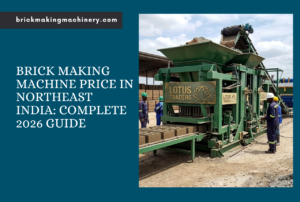
Brick making machines come in several types, each suited to different raw materials, production scales, and budgets. The India construction market is valued at USD 0.79 trillion in 2026 and growing — which means brick demand is only increasing. Here is what is currently available and what you can expect to pay across the Northeast India market:
| Machine Type | Price Range (INR) | Output (bricks/hr) | Best Suited For |
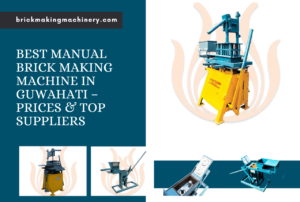
| Manual Fly Ash Machine | ₹1.5L – ₹5L | 800 – 2,000 | Rural/small units |
| Semi-Auto Fly Ash Machine | ₹5L – ₹15L | 2,000 – 6,000 | Mid-scale contractors |
| Fully Auto Fly Ash Machine | ₹15L – ₹50L+ | 6,000 – 20,000+ | Large commercial ops |
| Cement Brick Machine | ₹3L – ₹20L | 1,000 – 8,000 | Urban construction |
| Clay Brick Machine | ₹2L – ₹10L | 1,500 – 5,000 | Hill/traditional areas |
| Interlocking/Paver Machine | ₹4L – ₹25L | 1,000 – 6,000 | Roads, tourism sites |
Tip: For Northeast India’s terrain and logistics, mobile or semi-stationary machines are particularly popular because they can be positioned closer to construction sites — reducing transportation costs for heavy bricks.
Fly Ash Brick Making Machine Price: Why It Dominates the NE Market
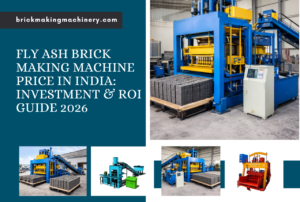
Fly ash is the most popular raw material for brick production across Northeast India. It is abundantly available as industrial waste from thermal power plants in Assam and surrounding states. It produces bricks that are lighter and stronger than traditional clay bricks, and it is more eco-friendly — a growing concern for contractors working on green infrastructure projects. According to JM Financial’s cement sector analysis, cement demand in India is projected to grow at a CAGR of 7-8% over FY25-27, with fly ash bricks riding the same wave.
Fly ash brick making machine prices in the Northeast typically break down as follows:
- Manual machines: ₹1.5 lakh to ₹5 lakh — ideal for village-level entrepreneurs and small contractors in states like Nagaland, Mizoram, and Manipur where remote locations limit heavy machinery.
- Semi-automatic machines: ₹5 lakh to ₹15 lakh — the most popular choice for mid-sized operations in Shillong, Guwahati, Agartala, and Imphal.
- Fully automatic machines: ₹15 lakh to ₹50 lakh and above — suited for large contractors supplying bricks to highway projects, railway infrastructure, or large housing developments under PMAY-G and PMAY-U 2.0.
Cement Brick Making Machine Price: Built for Northeast’s Urban Growth
Cement bricks are preferred for commercial construction, government buildings, and projects requiring high dimensional accuracy. With Guwahati expanding as a metro city and Agartala developing as a rail-connected urban center, cement brick demand is rising fast. The India construction market is expected to reach USD 1.10 trillion by 2031, with East India logging the quickest regional growth — making this the right time to invest in cement brick production capacity.
Entry-level cement brick machines start at around ₹3 lakh for small block producers. Mid-range systems in the ₹8 lakh to ₹15 lakh bracket are popular with urban contractors in Assam and Meghalaya. High-output automatic lines above ₹20 lakh are increasingly in demand for supplying bricks to the region’s large infrastructure projects.
Clay Brick Making Machine Price: The Hill Region’s Traditional Choice
Clay brick machines remain relevant across Northeast India’s hill districts, where local clay deposits are available and traditional building styles are maintained. In Arunachal Pradesh, Nagaland, and Mizoram — where terraced construction on hillsides is common — clay bricks and tiles continue to be widely used. Prices start at approximately ₹2 lakh for manual presses and go up to ₹10 lakh for automated systems. Their lower raw material cost makes them especially attractive for remote locations where transporting fly ash or cement adds significant logistics expense.
6 Factors That Determine Brick Making Machine Price in the Northeast
- Automation Level: A manual machine requires more labor but has a lower entry cost. Fully automatic hydraulic machines minimize labor dependency — a major advantage in states like Mizoram and Nagaland where skilled labor can be difficult to source.
- Production Capacity: Higher-output machines cost more but produce a lower cost-per-brick over time. If your market includes large infrastructure projects, the higher upfront cost pays back quickly.
- Transportation and Installation: In hilly northeastern states, getting a machine to your site can add 10–20% to your total cost. Choose a machine size that is realistically transportable to your location.
- Raw Material Compatibility: Some machines are optimized for a single material; others can handle fly ash, cement, and soil — making them more versatile for operations across diverse terrain.
- After-Sales Support: In remote areas of Arunachal Pradesh, Manipur, or Mizoram, reliable spare parts supply and service access is critical. Factor this into your buying decision, especially given the rapid growth of construction activity in these states.
- Power Availability: Fully automated machines require consistent power supply. In areas with frequent power cuts, consider machines with diesel backup capability or lower power draw.
Who Is Buying Brick Making Machines in Northeast India?
Small Rural Entrepreneurs: In states like Meghalaya, Nagaland, and Manipur, individual entrepreneurs are investing in manual or semi-auto machines to supply local construction. Under PMAY 2.0, hill states and northeastern states receive higher financial assistance — ₹1.30 lakh per house versus ₹1.20 lakh in the plains — creating consistent, subsidized demand for local bricks.
Tourism Infrastructure Developers: Homestay owners, resort developers, and hotel builders around tourism hubs — from Kaziranga to Tawang, Shillong, and Loktak — are purchasing bricks in volume. Kaziranga alone saw a 35% jump in tourist footfall in 2024-25, and new lodges and eco-resorts are rising to meet that demand.
Highway and Road Contractors: With 16,207 km of national highways already built in the Northeast and thousands more kilometres under construction under SARDP-NE and Bharatmala Pariyojana, road contractors require large volumes of bricks for culverts, walls, and support structures. These buyers typically invest in high-output automated machines.
Government Project Suppliers: The scale of government infrastructure across the Northeast — from hospitals and schools to railway stations — requires dedicated brick suppliers operating at commercial scale. Railway projects worth ₹77,000 crore are underway in the region, each project consuming massive quantities of bricks.
Real Estate Developers: Guwahati, Shillong, and Agartala are experiencing residential and commercial real estate growth driven by urbanization and improved connectivity. According to Mordor Intelligence, residential construction holds 44.68% of India’s construction market share in 2025, and East India is set to log the fastest regional growth.
How to Choose the Right Machine for Your Location in the Northeast
- Check machine dimensions versus your transport route: Hill roads in Arunachal, Manipur, and Mizoram may have weight and width restrictions.
- Assess local raw material availability: Fly ash is most accessible near Assam’s power plants. Clay is more accessible in hill districts. Choose a machine that aligns with your nearest material source.
- Calculate demand from your nearest construction cluster: Highway projects, PMAY housing schemes, and tourism sites are your primary buyers — estimate their volume needs before sizing your machine.
- Verify power supply reliability: Check if your site has consistent power or if you need a diesel-option machine.
- Ask for region-specific references: Request examples of other buyers in the Northeast who are using the machine you are considering.
- Understand permit and ILP requirements: If your operation is in Arunachal Pradesh, Nagaland, or Mizoram, factor in permit logistics for the movement of goods and equipment — the India-Japan Coordination Forum for Northeast Development is also opening new doors for strategic infrastructure investment in these states.
Why Choose BrickMakingMachinery.com for Northeast India?
We understand the unique demands of the Northeast market — from remote delivery logistics to diverse terrain requirements. Our machines are built in a state-of-the-art facility with advanced quality testing, ensuring every unit meets the performance expectations of contractors working in Assam, Meghalaya, Arunachal Pradesh, Nagaland, Manipur, Mizoram, and Tripura.
- Machines suited for all terrain types and raw materials
- Competitive brick making machine prices with transparent specifications
- After-sales support and spare parts supply for remote locations
- Bulk order discounts for contractors and developers
Conclusion: The Northeast Is Building — Be Ready to Supply It
Northeast India’s Seven Sisters are transforming. Highways are cutting through ancient hills, railways are reaching capitals that were once accessible only by road, tourism resorts are rising alongside sacred rivers and misty mountain valleys, and millions of new homes are being built under national housing schemes. All of this construction requires bricks — and bricks require machines.
Understanding brick making machine price in Northeast India means understanding the local construction landscape, the raw materials available in your state, and the scale of demand around you. Whether you are in Guwahati, Kohima, Aizawl, Shillong, Agartala, Itanagar, or Imphal — the opportunity to build a profitable brick manufacturing business has never been greater.
Use this guide as your starting point. Then contact our team at BrickMakingMachinery.com for a region-specific consultation and an updated brick making machine price list tailored to your state and project scale.